 |
| Kodava King Lingarajendra was assisted by his trusted soldier Thathanda Subbayya on several hunting expeditions to please British officers. A famous painting, depicting the king offering Subbayya a gold bracelet, a gun and a sachet of gold coins, is still in the ancestral home of the Thathanda family
Lingarajendra was not meant to be king. However, a series of lucky breaks landed him on the throne of Kodagu in 1811.
It was a combination of luck and chicanery that propelled him from being the timid younger brother of Dodda Veerarajendra to finally usurping the kingdom of Kodagu by cleverly dislodging the eleven-year-old daughter of his brother who had been named successor to the throne.
After the demise of Dodda Veerarajendra, Lingarajendra started asserting himself, and within a short time took complete control over his domain.
He was wise in maintaining good relationships with the powerful British who had established a strong presence in neighbouring Mysore after overthrowing Tipu Sultan.
One of the attractions Lingarajendra offered the British officers was organising elaborate hunting expeditions in the dense forests of Kodagu, which had abundant wildlife. As a protectorate of the British, there was no external threat to his kingdom. He diligently presented two elephants every year to the East India Company as a tribute.
Lingarajendra had a very loyal and trusted lieutenant in a young Kodava soldier called Thathanda Subbayya. Lingarajendra, though short in stature, was physically very tough. Also, he was very agile and athletic. He was an excellent horseman, a sharp shooter and an able archer. Subbayya was one of the few who could match him in marksmanship. This brought the two closer and Subbayya was Lingarajendra’s constant companion on every hunting trip of the raja.
Thathanda Subbayya rose rapidly in the court of Lingarajendra and was promoted to the post of kariakara which was equivalent to the position of an Army Commander. In a well-documented hunting trip of Colonel Welsh and Lieutenant Williamson in March 1811, it was Thathanda Subbayya who was in charge of all the arrangements for the elaborate shikari. Colonel Welsh who later became a General was extremely pleased with the sizeable booty of trophies he collected after the hunt. He promised all support for Lingarajendra and also requested the raja for another hunting adventure during October the same year.
After the departure of the guests, an immensely pleased Lingarajendra presented Subbayya with a gold bracelet, a gun and a sachet full of gold coins. He then announced a gift which was awarded only to very special subjects. It was to be painted in a portrait along with Lingarajendra.
This painting depicting a reverential Subbayya in front of Lingarajendra is still in existence at the ancestral home, or the aynmane of the Thathanda family in Kukloor village near Virajpet. When I visited the aynmane, the present residents allowed me to take a photograph of the painting which is placed in a recess of the wall next to the traditional hanging lamp known as thook bolucha. This is a sacred place in Kodava homes meant for offering regular obeisance to ancestors.
Taming the tiger
All the attention that kariakara Subbayya was receiving generated great envy amongst other members in the court of the raja. They felt threatened, and feared Subbayya would soon be promoted above some of the senior officers.
Few of his rivals waited for an opportunity to damage the reputation of Subbayya in the eyes of Lingarajendra. A few months later, Lingarajendra received an appeal from nearby villagers about a tiger that was terrorising the area and they wanted the raja to help them eliminate the beast.
Lingarajendra asked Subbayya to make all the arrangements and also set up a machaan (platform on a tree) for him to stalk the tiger. A live bait was tied in the vicinity to attract the big cat.
Subbayya who was an expert in setting up machaans immediately got on to the job and made all the necessary arrangements for the hunt. His foes took advantage of this event to discredit Subbayya. They surreptitiously sent their men to sabotage the machaan on which Lingarajendra was to camp overnight. The ropes used to tie the machaan were cut half-way to make it weak and unsafe.
Subbayya’s sacrifice
Lingarajendra got on to the machaan and Subbayya sat on another machaan set up atop another tree. A little after midnight, the tiger made its appearance where Lingarajendra sat waiting. There was no escape for the tiger with Lingarajendra’s accurate gunshot.
But, with the recoil of the powerful gun, Lingarajendra’s machaan gave way as the weakened ropes snapped. It was entirely the agility of the raja that enabled him to hold on to a branch and get down using the rope ladder.
Lingarajendra was furious and wanted Subbayya to be brought to him immediately. Subbayya who heard the gun shot got down from his machaan and was walking towards where Lingarajendra camped. He met the soldiers on the way who were looking for him. The soldiers narrated what had happened.
Subbayya who knew the raja’s explosive temper was sure he would be killed on sight. He told the soldiers that he would follow them. He then sat under a tree and shot himself in the chest with the gun that Lingarajendra had presented him months earlier.
When Lingarajendra learnt about Subbayya having taken his own life, he was most upset. He had complete faith in Subbayya and had no intentions of harming his loyal kariakara. He vowed to investigate the incident and punish the culprits.
Subbayya was still a bachelor and was planning to get married soon. He was a rising star among Kodavas at the time. Lingarajendra bitterly grieved Subbayya’s untimely demise. He built a memorial (in Lingayat style) in honour of his trusted kariakara in Kukloor village. This monument is well-maintained by the Thathanda family even to this day.
Lingarajendra ruled Kodagu for nine years. The economy of Kodagu improved during his tenure and there was no threat of war. For the battle-weary citizens of Kodagu, this period of peace came as a great reprieve.
Lingarajendra, however, turned despotic during the later part of his reign. His son and the last raja of Kodagu, Chikka Veerarajendra succeeded him in 1820. In 1834, the British dethroned the unpopular Chikka Veerarajendra and Kodagu came under the direct rule of the East India Company. Chikka Veerarajendra was ingloriously exiled to Benares.
Courtesy : Deccan Herald Author: C.P. Belliappa |
Categories:
Recent History |
 |
| Veerarajendrapete, or today's Virajpet, was built by Kodagu ruler Dodda Veerarajendra to celebrate his cordial relationship with the British. The town has streets named Bengali Street, Jain Street and Telugu Street, after people from neighbouring regions arrived here following an invitation from the king
Dodda Veerarajendra sat on the throne of Kodagu from 1791 to 1809 and is considered the hero of Haleri dynasty that ruled the land for more than 200 years. Dodda Veerarajendra was baptised by fire as it were.
As a young man in his mid-twenties, he crafted a dramatic escape in 1788 after having been in Hyder Ali and Tipu Sultan’s captivity for eight years. By 1791, with help from Kodava chieftains, he managed to gradually gain control over his kingdom.
In 1790, he signed a friendship treaty with the East India Company and formed an alliance with the British. It was in April 1791 that a senior British officer, General Robert Abercrombie, who was also the Governor of Bombay, visited Kodagu to hold discussions with Dodda Veerarajendra regarding specific help that they wanted from him.
General Abercrombie had travelled from erstwhile Bombay and was on his way to Srirangapatna. Dodda Veerarajendra met the General who arrived from Tellichery.
The location where they met was on a hillock about ten kilometres from the border.
The General was quite taken-up with the indomitable young raja. As required by the British, the raja readily provided supplies for their troops, beasts of burden to transport war material, and a place for the horses and elephants to be looked after.
He also agreed to provide land for setting up a field hospital to treat war casualties. In 1792, General Abercrombie again met the raja of Kodagu on his way back from Srirangapatna, at the same spot as their earlier meeting. The raja had made elaborate arrangements to make the General’s stay comfortable.
The elevated spot provided a panoramic view of the Western Ghats. During this visit they had more time to discuss a variety of subjects. General Abercrombie was fascinated by Dodda Veerarajendra’s narration of the history of the Haleri dynasty. He requested the raja to record these details which Dodda Veerarajendra did, several years later, under the title – ‘Rajendraname’.
This is the only recording of the early history of Kodagu. General Abercrombie later became the commander-in-chief of the British Army in India. He remained a good friend of Dodda Veerarajendra and was instrumental in Rajendraname being translated to English.
Dodda Veerarajendra was very happy after these two meetings with General Abercrombie. He felt secure after gaining British support. He wanted to commemorate this historic development and decided to found a town around this hillock where he had important discussions with the British general. He named the town after himself, Veerarajendrapete, and started construction of a fort and an ammunition dump on this hillock. A little distance away a pond was dug for the horses and elephants to be serviced.
Earlier wars had depopulated Kodagu to a great extent. Dodda Veerarajendra invited people from neighbouring areas with promise of land to settle down in Veerarajendrapete. Amongst those who made Kodagu their home were about 100 Muslim men and women from Kannur whose ancestors had earlier fled Bengal in 1757 after the Battle of Plassey.
About 700 Christians also took refuge in Kodagu. Dodda Veerarajendra provided land for them to build a church, St. Anne’s Church, which is very much in existence to this day. In addition, there were Mudaliars, Jains, Telugu Chettis and Moplahs from Kerala who settled down in the new town. Veerarajendrapete gradually came to be known as Virajpet. Presently, this busy town has streets named Bengali Street, Jain Street and Telugu Street depending on the original settlers.
This fort in Virajpet was last mentioned in a letter dated February 24, 1837 written by General Mark Cubbon the British Commissioner in Bangalore, to Captain C T Le Hardy the Superintendent of the then Coorg, granting a sum of Rs 150 for repairs. However there is no trace of this edifice now except for the two entrance gate-posts.
It is surprising that these remnants of the first structures to be built in Virajpet as far back as 1792 have not been paid much attention to. The gate-posts have withstood the ravages of time, but have ingloriously become a part of the wall surrounding the PWD Inspection bungalow which now occupies the site where Dodda Veerarajendra met General Abercrombie.
Courtesy : Deccan Herald Author: C.P. Belliappa |
Categories:
Recent History |

The construction of the Omkareshwara temple in Madikeri was completed in 1820 by Lingarajendra, the penultimate raja of Kodagu. The Shiva temple has a unique and most unusual architecture. It has a central dome with turrets in the four corners. The design reflects fusion of Hindu, Gothic, and Islamic style of construction. A beautiful water tank located in front of the temple adds to the serenity of this place of worship. There is a mantapa in the middle of this pond, which is connected by a causeway. The tank is full of gold fish of various hues, and is a visual treat.
The Shiva linga installed in the sanctum sanctorum was brought from Kashi (Benares) by three men who were specially deputed by the king to fetch the sacred stone icon. During its arduous transportation, the linga was never placed on the ground. The three men took turns carrying the linga and diligently performed the prescribed poojas at sunrise and sunset. Work on the temple started in 1817 and the linga was consecrated in the shrine on March 26, 1820.
This occasion was celebrated for three days, and all the citizens of Madikeri took part in various rituals. Hundreds of devotees were provided free meals during the three days of festivities. Lingarajendra arranged for a lamp to be lit inside the temple in perpetuity – a practice which is being continued to this day.
However, there is a dark story behind the construction of this temple. Lingarajendra took control of the kingdom of Kodagu rather tenuously in 1810. He soon consolidated his position and within three years became a feared raja to his subjects. It was in the beginning of 1817 that a poor old man from Puttur brought his beautiful daughter to Madikeri. His wife had died and the old man was rather desperate to ensure a secure future for his daughter. In his anxiety, he imprudently decided that his daughter could be one of the wives of the prosperous raja of Kodagu. He wanted to meet the raja along with his daughter.
Lingarajendra was away on a hunting expedition at the time. The old man and his daughter were wandering in Madikeri for shelter when they were directed to meet a prominent man in town named Subbarasaiah. When Subbarasaiah heard about the purpose of the Puttur man’s visit, he was aghast. He reprimanded the old man for his foolishness. After providing them food and shelter for a day, he urged them to get back to their village before the raja’s return.
But the town was full of spies who immediately informed Lingarajendra how Subbarasaiah had sent back a prospective bride for the raja. Lingarajendra was enraged and sent his dreaded Siddi guards to bring Subbarasaiah to his court. Lingarajendra thundered at Subbarasaiah’s insouciance. He ordered him to immediately get the girl back to Madikeri. Subbarasaiah pleaded that he had absolutely no knowledge of the whereabouts of the old man and his daughter. Lingarajendra warned Subbarasaiah and his family of dire consequences.
Subbarasaiah’s fate
When he did not relent, Lingarajendra asked his guards to bring to the court the two young sons of Subbarasaiah. Lingarajendra threatened that they would be beheaded if Subbarasaiah did not tell him where to find the old man and his daughter. Subbarasaiah beseeched Lingarajendra and pleaded his ignorance. Lingarajendra barked his orders and the Siddi assassins lost no time in executing their master’s instructions. Subbarasaiah fainted on seeing the horror.
When he recovered, he was so devastated that he did not care for his own life any longer. He cursed and berated the raja. Lingarajendra ordered Subbarasaiah be cut limb by limb. The Siddis were merciless. As life ebbed from his body, Subbarasaiah swore he would return as a Brahma Rakshasa, and torment the raja for the rest of his life.
From that day onwards, Lingarajendra started seeing the apparition of Subbarasaiah. He could not sleep, and very often found himself rolling off his cot.
He was advised to perform various poojas to appease the Brahma Rakshasa but none worked. His health deteriorated drastically. Finally, Neeleshwar Tantris from Mangalore were consulted. After much study of their manuscript on exorcism they suggested construction of a temple dedicated to Shiva where the Brahma Rakshasa be given a place to reside. They also recommended that the Shiva linga should come from the holy city of Kashi.
Lingarajendra finally found peace but it lasted only a few months. The thought of Subbarasaiah’s ghost started tormenting the raja once again. Lingarajendra literally went insane and died by the end of 1820 aged 45. Subbarasaiah’s premonition had come true.
Courtesy : Deccan Herald
Author: C.P. Belliappa
Categories:
Recent History |

This is one of the oldest edifices in Kodagu which is still in its original state. Though a modest construction, it has an interesting story behind it.
It was built around 1700 by Acchu Nayaka in honour of his benefactor Nanjunda Urs, who was the ruler of neighbouring Periapatna.
Acchu Nayaka’s descendants continue to live in the same premises where Acchu and his father Chittiappa Nayaka lived more than 300 years ago. I visited this location, and the residents enthusiastically showed me the kaimada and the courtyard where Acchu and Kodava commander named Paradanda Ponnappa had their duel.
There are two stone carvings inside the kaimada. One of them is that of Nanjunda Urs. The pièce de rèsistance is an amazing relic from the past. One of the men took me to a spot nearby, and with a stick dug the earth a couple of inches. There was black material underneath. He scooped out a handful and held it. It was charred paddy. The gentleman explained that this was the remnants from the granary that was set ablaze when Chittiappa Nayaka was attacked three centuries ago!
Acchu Nayaka had a traumatic childhood. His father Chittiappa Nayaka was a powerful warlord in the region, but had many enemies. Chittiappa Nayaka and his family lived in a well-guarded mud fortress.
However, on one fateful day, he and his soldiers had let down their guard while celebrating nari-mangala (tiger-wedding) which was a special event when a man slays a marauding tiger in his domain. His people were grateful to Chittiappa Nayaka for having gotten rid of the beast which had terrorised them for many months.
In celebration, Chittiappa Nayaka and his close aides imbued large quantities of the local brew – bollekallu – and by nightfall they were in a stupor. Aware that Chittiappa Nayaka’s defence was compromised, his detractors surreptitiously attacked his fortress and set fire to the dwellings within the walls of the compound.
There were haystacks and granaries nearby. The fire soon engulfed the entire area. Though Chittiappa Nayaka and his men regrouped and fought gallantly, but their resistance was quelled, and the entire family perished in the inferno except for Chittiappa Nayaka’s new-born baby boy who was rescued by Ayyavva the maid.
Nanjunda Urs’ benevolence
Ayyavva carried the baby, and after travelling under great odds reached Periapatna. She found a job in a farm and brought up Chittiappa Nayaka’s son as her own. She affectionately called him ‘Acchu’.
Acchu grew to be a sturdy and good-looking lad by the time he was seven years old. He was noticed by Nanjunda Urs, the ruler of Periapatna, during Ugadi celebrations one year. When Ayyavva was asked about the boy, she rather unconvincingly answered that he was her son.
When Nanjunda Urs quizzed her further, Ayyavva lost her nerve and narrated the story of Acchu and his father Chittiappa Nayaka. Nanjunda Urs immediately had both Ayyavva and Acchu shifted to his palace where Acchu grew up with the children of the ruler. Acchu received education and training in martial arts along with the sons of Nanjunda Urs. He excelled in warfare and statecraft, and as an adult proved a valuable asset to Nanjunda Urs.
Acchu learnt from Ayyavva the horrendous atrocities committed on his family. He now sought revenge, and was determined to reclaim his father’s domain. Nanjunda Urs readily agreed to assist Acchu in this quest and offered the services of 500 of his soldiers. Acchu marched with this band of well-armed men and succeeded in taking possession of not only his father’s realm but also those of his detractors. Acchu Nayaka, as he was known, soon became a popular and powerful ruler in south Kodagu.
Enter the Haleri dynasty...
By then, in the northern parts of Kodagu, a minor faction of Lingayat rulers from Shimoga established their reign in Haleri – a small village known for milk production. They came to be known as the Haleri dynasty, which ultimately ruled Kodagu for more than two centuries.
Siribai Veerappa Raja was the fourth generation ruler from the Haleri dynasty and a contemporary of Acchu Nayaka. When Siribai Veerappa demanded Acchu Nayaka pay him tribute, it was flatly refused. The Haleri Raja was on a mission to extend his sovereignty all over Kodagu.
He despatched a strong army led by an able Kodava commander named Paradanda Ponnappa, to subdue Acchu Nayaka. Many attempts by Ponnappa to storm the bastion of Acchu Nayaka were repelled. Acchu Nayaka sent his emissaries to Ponnappa to join hands with him to drive the Lingayat rulers out of Kodagu; but Ponnappa was not prepared to betray Siribai Veerappa.
Unable to defeat Acchu Nayaka, Ponnappa and his men managed to sneak into the fortress of Acchu while he was away on one of his hunting expeditions. They took his family hostage.
On his return, Acchu was infuriated but could do very little. He then challenged Ponnappa for a one-to-one combat. Ponnappa accepted the challenge and the two warriors fought in the open court-yard. They were equally matched and the fight went on for several hours. Both were badly injured.
Finally, it was Ponnappa who emerged victorious. Ponnappa could have killed his rival, but spared his life. Ponnappa waited for two weeks for Acchu to recover from his injuries. He too had to nurse his wounds. Ponnappa then took Acchu Nayaka to Siribai Veerappa as a prisoner.
When the raja heard about the entire episode he was full of admiration for Acchu Nayaka. He treated him as an equal and extended all courtesies. However, Acchu Nayaka and his family were under house-arrest till Acchu’s demise.
Courtesy : Deccan Herald
Author: C.P. Belliappa
Categories:
Recent History |
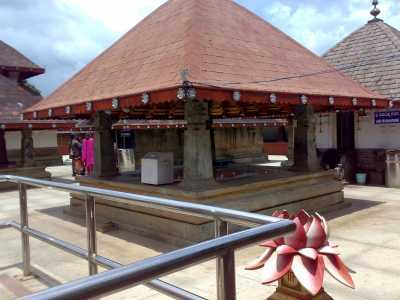 |
| Kodagu’s Paadi Igguthappa temple became a prominent place of worship during King Lingarajendra’s reign. The temple, located atop a hill in a forested area in Kakkabe, has been in existence since 1153 |
Goddess Cauvery and Lord Paadi Igguthappa are the two presiding deities of Kodagu. If legends are to be believed, Igguthappa temple located atop a hill in a forested area in Kakkabe, in the southern part of Kodagu, has been in existence since 1153 AD. Legend also has it that Igguthappa is one of the seven divine siblings who chose Kodagu as his abode.
The temple became a prominent place of worship during Lingarajendra’s reign. Legend has it that in 1811, Lingarajendra came to the densely forested area surrounding the temple to hunt for elephants. Lingarajendra’s main source of income, besides taxes collected from his subjects, used to be cardamom and ivory. Every pod of cardamom grown and every tusk extracted from an elephant had to be surrendered to the raja at a price fixed by him!
Lingarajendra was camping at the nearby Nalknad palace and had instructed his dewan Apparanda Bopu to organise the hunt. Dewan Bopu arranged for machaans to be built on trees and had hunting dogs and drum-beaters to herd the elephants. On the appointed day Lingarajendra and Bopu sat on a machaan armed with powerful guns especially designed to shoot elephants.
The temple became a prominent place of worship during Lingarajendra’s reign. Legend has it that in 1811, Lingarajendra came to the densely forested area surrounding the temple to hunt for elephants. Lingarajendra’s main source of income, besides taxes collected from his subjects, used to be cardamom and ivory. Every pod of cardamom grown and every tusk extracted from an elephant had to be surrendered to the raja at a price fixed by him!
Lingarajendra was camping at the nearby Nalknad palace and had instructed his dewan Apparanda Bopu to organise the hunt. Dewan Bopu arranged for machaans to be built on trees and had hunting dogs and drum-beaters to herd the elephants. On the appointed day Lingarajendra and Bopu sat on a machaan armed with powerful guns especially designed to shoot elephants.
In spite of all the drum-beating and dogs barking, not a single elephant was to be seen. The raja started getting restless and directed his ire at Bopu. Lingarajendra’s nasty temper was well-known and Dewan Bopu who was a devotee of Igguthappa started silently praying for some divine intervention. Suddenly a huge pachyderm with mammoth tusks appeared silently from the nearby bushes.
The elephant looked up at the machaan where Lingarajendra and Bopu were seated and started scratching itself on the tree trunk. The raja and dewan froze and were too petrified to shoot the beast. The action of the elephant shook the large tree so violently that they were about to fall off from their perch. This time around, Dewan Bopu prayed loudly to Lord Igguthappa to save him and the raja. Lingarajendra too joined Bopu in prayer. Suddenly the behemoth stopped, once again looked up, and gently sauntered away into the forest.
Lingarajendra, a Lingayat, was a worshipper of Shiva and had not visited Igguthappa temple which was dedicated to Vishnu. He made an exception and asked Bopu to immediately take him to the temple. It was a modest shrine. The head-priest welcomed the raja and advised him to perform various poojas including tulabhara (donation of grains equivalent to the weight of the devotee), to thank Igguthappa for saving his life.
After all these rituals, Lingarajendra asked the priest if he could do anything for the temple. The priest was quick to request for a punarnirmana (renovation) of the temple.
Lingarajendra immediately agreed and the temple was renovated and the approach improved. He also made grants of wet-lands in the vicinity, the income from which continues to be used for the upkeep of the temple. When the reconstruction was completed, he visited the temple again. At the temple, he had a sack full of silver coins brought. Lingarajendra dipped both his hands and scooped out three heaps of silver coins. He then ordered Dewan Bopu, who was present, to get an idol of an elephant made out of the coins. The coins weighed about three kilograms.
Silver elephant
The best silver-smiths from Mangalore were commissioned to craft an idol of an elephant. On the back of the idol is inscribed in halagannada (old Kannada), the year in which it was dedicated to Igguthappa for favours granted to Lingarajendra. This exquisite silver elephant is used daily in the poojas performed at the temple.
In 1835, the year after Lingarajendra’s son Chikka Veerarajendra was deposed by the British, Dewan Apparanda Bopu took it on himself to renovate the temple. The structure was reconstructed and was fitted with tiles replacing the earlier thatched roof. The temple once again went through reconstruction in 2008. Descendants of Apparanda Bopu along with other devotees have provided silver cladding for the entrance door.
Paadi Igguthappa is an important deity for the people of Kodagu. He is considered a provider of bounty and one who fulfills his devotee’s wishes. Iggu means grain and thappa means give.
Puthari, the harvest festival in Kodagu, is normally celebrated 90 days after Onam. Every year, paddy is first harvested in fields belonging to Lord Igguthappa. People of Kodagu celebrate the festival the following day. On a daily basis, those who visit the temple are served a simple but scrumptious lunch.
Courtesy : Deccan Herald
Author: C.P. Belliappa
Lingarajendra, a Lingayat, was a worshipper of Shiva and had not visited Igguthappa temple which was dedicated to Vishnu. He made an exception and asked Bopu to immediately take him to the temple. It was a modest shrine. The head-priest welcomed the raja and advised him to perform various poojas including tulabhara (donation of grains equivalent to the weight of the devotee), to thank Igguthappa for saving his life.
After all these rituals, Lingarajendra asked the priest if he could do anything for the temple. The priest was quick to request for a punarnirmana (renovation) of the temple.
Lingarajendra immediately agreed and the temple was renovated and the approach improved. He also made grants of wet-lands in the vicinity, the income from which continues to be used for the upkeep of the temple. When the reconstruction was completed, he visited the temple again. At the temple, he had a sack full of silver coins brought. Lingarajendra dipped both his hands and scooped out three heaps of silver coins. He then ordered Dewan Bopu, who was present, to get an idol of an elephant made out of the coins. The coins weighed about three kilograms.
Silver elephant
The best silver-smiths from Mangalore were commissioned to craft an idol of an elephant. On the back of the idol is inscribed in halagannada (old Kannada), the year in which it was dedicated to Igguthappa for favours granted to Lingarajendra. This exquisite silver elephant is used daily in the poojas performed at the temple.
In 1835, the year after Lingarajendra’s son Chikka Veerarajendra was deposed by the British, Dewan Apparanda Bopu took it on himself to renovate the temple. The structure was reconstructed and was fitted with tiles replacing the earlier thatched roof. The temple once again went through reconstruction in 2008. Descendants of Apparanda Bopu along with other devotees have provided silver cladding for the entrance door.
Paadi Igguthappa is an important deity for the people of Kodagu. He is considered a provider of bounty and one who fulfills his devotee’s wishes. Iggu means grain and thappa means give.
Puthari, the harvest festival in Kodagu, is normally celebrated 90 days after Onam. Every year, paddy is first harvested in fields belonging to Lord Igguthappa. People of Kodagu celebrate the festival the following day. On a daily basis, those who visit the temple are served a simple but scrumptious lunch.
Courtesy : Deccan Herald
Author: C.P. Belliappa
Categories:
Recent History |

A system of land tenure, known as Jamma, was formerly instituted in Kodagu during the pre-colonial Paleri Dynasty of the Lingayat Rajas . Jamma agricultural lands (generally reserved for wet-rice cultivation) were held almost exclusively by Kodavas as a hereditary right, and were both indivisible and inalienable. Importantly, rights over the adjacent forests (bane) were also attached to Jammatenure, such that relatively expansive agricultural-forestry estates have remained intact across Kodagu. The exclusion of plantation crops, such as coffee, from India’s Land Ceiling Act has further insulated these holdings from postindependence land reform efforts across India. Importantly, rights over the adjacent forests (bane) were also attached to Jamma tenure, such that relatively expansive agricultural-forestry estates have remained intact across Kodagu. A unique feature of Jamma tenure is that tree rights remained with the Rajas, and were subsequently transferred to the colonial and post-independence governments and remains an import determinant of land use practices in the district.
Ever since Kodagu, which was a “C” State after Independence, was integrated with the then Mysore State, now Karnataka, in the year 1956, the original inhabitants of Kodagu, with the majority ethnic group Kodavas after whom the name Kodagu is apparently derived, including Amma Kodavas, Kodagu Gowdas etc., and the tribals with their own land tenure, specially Jammma Bhoomi, have been pestered by four major problems.
One is about Jamma land holdings. Second, the land owners right over trees. Third, the recommendation by the Committee to declare Kodagu as a deemed forest area and fourth one is the delimitation of the Parliamentary and Assembly Constituencies of Kodagu by the Delimitation Commission.
All these four issues directly affect the original inhabitants of Kodagu to an extent that there is a danger of disintegration of Kodagu as a geographical entity that existed for centuries, even before the Lingayat Rajas and later the British, came to rule Kodagu. Though many promises were made about protecting the political and property rights and privileges of Kodavas and other original inhabitants of Kodagu by the Karnataka government at the time of integration, the conduct of the subsequent governments belied all those promises. Take for example, the Jamma Bane holdings.
The government has been issuing notifications that questioned the rights of Jamma holders contrary to what has been held as their absolute property except to the condition that in case any Jamma holder wants to alienate or sell the property, he should do so only to another Jamma holder and that too after obtaining permission from the then Commissioner of Coorg (later the Deputy Commissioner) paying a Nazrana, a fee to the government, decided as per set norms.
This is the most far - sighted and wise law set down by the Lingayat Rajas and followed by the British as they realised its beneficial effects, both on the geography and the original inhabitants of Kodagu. The reason for adopting this kind of land tenure can be traced to the early days of Kodagu, which was a thickly forested highland with hills, valleys, and heavy rainfall, which would touch 300 inches in certain areas, pouring almost for six months in a year from May to October. As a result, Kodagu was a place infested with malaria and wild animals. People were afraid not only to settle down in Kodagu as agriculturists but also afraid even to go to Kodagu as laborers.
It was noticed by the Rajas that people were even abandoning their land and going away to the planes. This would not only affect the revenue to the Palace (the government) but there was a danger of not getting enough soldiers for the King's army. It was under these circumstances the King came up with a new kind of land tenure in the form of reward for military service and incentive for the inhabitants to remain in Kodagu.
With the kind of restrictions put on the Jamma holdings the land owners were prevented from selling their land and going away. However, the exemption and concession in land revenue on these Jamma holdings made the land owners to stay back in Kodagu taking in their stride the hazards of living in a land infested with malaria, heavy rains and wild animals. History says when Tippu Sultan was killed in the last Mysore war hundreds of Konkan Christians fled Srirangapatna back to Mangalore and Kharwar via Kodagu. The then King Doddaveera Rajendra requested them to remain in Kodagu by granting Jamma lands. That's how there are many landholding Jamma Christian families in Kodagu.
With the advent of the British (1834) Kodagu was opened up for coffee plantation and the living conditions improved. All the same the British thought it wise to respect the Jamma and other land holdings enjoyed by a large number of Kodavas and others with pride. This has indeed helped Kodagu to remain, to a large extent, in the hands of Kodavas and other original inhabitants till now.
However, a few years back a case was filed in which issues relating to the Jamma tenure and the right to alienate such property to whomsoever one liked were discussed and even a court verdict had emerged upholding sale of Jamma property to non-Jamma holders and get the khatha transferred to the buyer's name. Subsequently government issued a notification claiming Jamma land to be the property of the government with the owner having only the right to cultivate without any rights for the standing timber and minerals. This again created anxiety among the Jamma property owners.
It is indeed disturbing that even to this day neither the government nor the holders of Jamma property really know each other’s rights and privileges in this regard.
In a place like Kodagu families with distinct names with a common house (Ayn house) surrounded by a cluster of houses, cultivating their landed property of Jamma and other tenures live in peace, homogeneously, with a common culture, language, custom and celebrating festivals, having their own temples.
If any member is allowed to sell the property to an outsider who may belong to another religion, another caste and community, speaking a different language, there is bound to be some sort of disturbance to peace and harmony at some time or the other with recurring frequency. Not that such a situation does not exist now but it is rare and only in few places. If Jamma tenure is abolished and the properties are turned into free holdings, indeed there is a danger of many selling their property to outsiders and leaving Kodagu for good.
If this trend continues, after a period the demography of Kodagu will change so also its geography. As it is, lot of landed property is changing hands from the locals. What with Kodagu being considered a tourist destination and a number of Holiday Homes and Holiday Resorts mushrooming all over Kodagu. Soon it will be a Kodagu without Kodavas, the major ethnic group and other indigenous groups. Kodava is a community, which has its origin in Kodagu. Just as what Punjab is for Punjabis, Kashmir is for Kashmiris (including Kashmiri Pandits), so is Kodagu for Kodavas. The State and Central governments should protect the Kodavas and help them to stay in the present defined geographical area where they really belong. If Jamma property rights are abolished Kodagu will not be there for Kodavas and other original inhabitants numbering about 20.
Incidentally, there is a school of thought in Kodagu that belives this Jamma land tenure is a great impediment in developing the plantation and the land. Reason: The financial institutions, banks and Credit Co-operative Societies, do not advance or lend money on the security of Jamma land, as its owners are not absolute owners in the eye of law. If this is so, the government may take remedial steps to remove this hurdle in the new Land Reforms Act likely to be enacted soon.
However, there is some hope now that the District in - charge Minister Ramachandra Gowda has said recently that Kodagu would get Jamma rights in the new Land Reforms Act. Some hope this to save Kodagu for the locals.
The other issue relates to the land owners' right to the standing trees. Here there are two categories of land — redeemed and unredeemed. If the owner has already paid the fee for felling and selling the trees it is redeemed. If it is not redeemed he has to apply and obtain permission by paying the required fee whatever. It is here the Forest Department is giving hell to the tree owner and it is here one may find the cesspool of corruption. Even to cut a tree to build one's own house is impossible and can be made possible only with bribe. Even genuine cases are not considered suspecting the intention of the owner. However, if bribe is paid the suspicion disappears. The law regarding the standing trees in Kodagu on private lands indeed needs a re - look.
To add insult to injury there is now a move to declare Kodagu as a deemed forest area inviting, with such declaration, all the legal restrictions and natural difficulties in cultivating plantation crops like coffee, cardamom, pepper, orange etc. There is an apprehension if it would be possible to cultivate these commercial crops in a manner that would give maximum or optimum yield if the trees are not allowed to be cut or trimmed for maintaining the required shade. It is hoped with such a declaration as 'deemed forest area' the residents are not forced to relocate themselves from Kodagu just as the tribals are being relocated from the reserved forests of Kodagu!
Now let us turn our attention to the danger of liquidation of Kodagu as a geographical and administrative entity by the Delimitation Commission headed by Justice Kuldeep Singh. Who knows this may be a prelude to the disappearance of Kodagu as a district in time to come. According to reports, Kodagu will have two MLAs instead of the present three. There was no independent MP for Kodagu ever since it was integrated with Karnataka in 1956. It was made part of the Mangalore Parliamentary constituency. Now the Kuldeep Singh Commission says Kodagu will have only two Assembly constituencies, Madikeri and Virajpet. The present Somwarpet constituency will be merged with Madikeri constituency. And the two Assembly constituencies will go to the newly created Mysore West Lok Sabha constituency and not the present Mangalore constituency.
This kind of division of constituencies has left people wondering if there is a political game plan to erase Kodagu, even as a district, from the map of Karnataka. People apprehend this to be a prelude to future liquidation of Kodagu as an independent entity with its own geographical and administrative boundaries. It is almost like a big fish swallowing the small fish. However, in a true democracy, in a pluralistic society like ours, the peoples' representatives should be selected not merely on the basis of the number of people residing in a given area but also by according representation to indigenous ethnic groups with their own distinct culture and language, living in areas like Kodagu. Malaysia model, which is working very well, is a good example here.
If the issues mentioned above are not deliberated in a rational and humane manner and negotiated with the State and Central governments by the people affected, the Kodavas and other indigenous groups living in Kodagu will not only lose their land but also their identity. If proper protective steps are not taken by the Kodavas and other indigenous groups in Kodagu, in the next 20 years Kodagu will become the playing field for outsiders to selectively deforest the land and turn it into a destination for holiday resorts and holiday makers. There seems to be a conspiracy. The idea of declaring Kodagu as an area of "Deemed forest" will help this tourism industry entrepreneurs immensely but not the farmers and planters. If it happens, Kodavas could be seen only in some museums with live models dressed in their traditional attire — like the Red Indians in some American museums.
The tragedy of Kodagu is the crisis of leadership and division of opinions amongst the stakeholders. It could be for reasons of individual self-interest, for reasons of caste or simple machination by immigrant traders, entrepreneurs and laborers who have no sentimental bond towards Kodagu. So the new slogan for Kodagu should be, sons of the soil wake up and unite now. You have everything to lose if you do not. Tomorrow it may be too late.
Categories:
Articles |
German multi-linguist devises a script with 34 alphabets
 |
| Dr Greg Cox |
 |
| PATH-BREAKING: The Kodava script devised by German multi-linguist, Gregg M. Cox |
Kodavas and Kodava-related issues have been in the news. Be it inventing a new script for the Kodava language or determining the origin of the Kodavas through DNA tests. Reactions, barring a few individuals and organisations, have been few in comparison with the slew of write-ups that have appeared in the media.
Efforts were made in the past by some to devise a script for the Kodava language. They include script by the late Iychettira Muthanna, who has authored books in Kodava, Kannada and English. But, a reluctant Kodava society did not pay much heed to it.
The “Coorgi-Cox Alphabet,” now devised by a German multi-linguist, Gregg M. Cox, is in the news in Kodagu, of late. The 34 alphabets and a double vowel in addition, make an interesting sight. How Dr. Cox, who speaks 64 languages and whose name has found a mention in the Guinness Book of Records, formulated the alphabets, is now known to many. A few say Dr. Cox must be complimented for his efforts to bring out photographs, compact discs and even introducing a contest to popularise the script at his own cost.
Categories:
Research |