A Kodava wedding is perhaps the only Hindu wedding ceremony, where the rituals are conducted without a priest and there is no puja; and where alcohol and meat is always served. The groom claims his bride after a member of his clan has killed mock banana trunk soldiers after which the elders bless the newly married couple.  The food is brilliant non-vegetarian fare, and there is a lot of dancing.” Shooting a Kodava wedding is a different experience altogether; “Its a fun and happy ceremony and very regal- the clothes worn by the clan are an expression of the regal status. There will never be a person who turns and awaits to be photographed. It is so personal. People only want to bless the couple.”

The groom wears a white kupya (robe) with a chele (sash) and a churidar. The white brocade turban imparts a majestic look

The bride wears a red silk sari with dots draped in the signature Coorgi style. Teamed with a red long-sleeved blouse and a red veil that covers her head. The sari is handed down as an heirloom


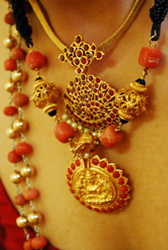
Gold jewellery is worn on the hair, ears, wrists, fingers and neck. Silver jewellery for the feet and a jasmine garland complete the look


They worship their ancestors and therefore there is no priest. After the honour of cutting the banana plant stems, an elder guides the families through some rituals. The rest of the ceremony is family and friends blessing the couple with rice

A land of chivalry and pride, a life of solitary splendour, rich food and spices


If the men are known to be very strong, Coorg women are known for their beauty and confidence

Photographs courtesy- www.markswaroop.com

Read More …


Coorg jewellery is very distinctive, yet the influence of neighboring States is evident. The jewellery worn by the Coorgs are inspired by nature, in the form of flowers, fruits, serpents, the moon, sun, and stars.


The 'Karthamani' and 'Pathak' are both symbols of marriage in Coorg. The former, fine black beads strung on a gold chain, sometimes made with as little as two grams of gold are common to both South and Western India.

Coorg jewellery pathak

The ‘Pathak’ is usually a half sovereign, or a larger gold coin, engraved with Goddess Lakshmi or Queen Victoria, framed by rubies, surmounted by a cobra, with hanging fresh water pearls, and a chain of gold and coral beads on a twisted strand of black glass beads.
Coorg jewellery pathak
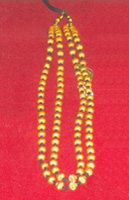
The 'Jomale' which consists of gold moulded grooved beads strung on black cord, about 71 cms long, is a necessary part of a Coorg bride’s wedding jewellery. The hollow beads are filled with lac. Nowadays, the Jomale is strung on different coloured threads to make a fashion statement.
Coorg jewellery Kokkethathi
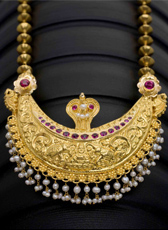
The 'Kokkethathi', a crescent shaped repousse pendant set with graduated cabochon rubies, framed with sea pearls, filled with lac, and a chain of ' Gund ' or hollow gold beads, is mandatory for a Coorg bride. The pendant has the image of a seated Lakshmi, Goddess of Wealth, flanked by two birds, by a cobra with a distended hood, which is a multiple symbol of wealth and fertility. The chain is usually 26 inches long to show it off to advantage.
The Coorg bride has a choice of beautiful bangles – The 'Kadagas' are gold hollow bangles, that literally clasp the wrist. They could be made of a single, double or triple bands of gold ornamented with twisted gold wire and rubies.
The 'Paunchi', which has gold grains in two or three recurrent rows, is a work of art, as is the 'Vajrachudi', which is supposed to represent jackfruit. 'Pimbale', and 'Piribale' are simpler gold bangles.
The Coorg head ornaments, are of South Indian origin. The main head piece usually has Shiva and Parvathy with Ganapathy, and the ornament is made to stay firm, with three strands of hair woven through a slit in the jewel. The 'Jadaenagara', includes the ‘Suryamukhi' and the 'Chandramukhi' and the 'Kutchu' of 3 black strings, ornamented with gold which hold the plait in place.
As the bride walks to the 'Mantap', or stands for the Ganga Puja, her feet are very much in focus. The jewellery she wears on her feet, in silver, are special to Coorg and represent the finest craftsmanship of the local jewellers. There are individual toe rings attached to chains, linked to the ankle chains all of which are finely crafted.
The earrings could be 'Jhumkis' , 'Muravu' or 'Bogadi', all of Carnatic origin, and mostly gold, ruby and pearls.

The repousse work commonly used in Coorg jewellery , uses a small quantity of metal, beaten to paper thinness, to convey an impression of weight and solidity, and a three dimensional effect.
The Coorg sari needs to be pinned with a 'brooch' – and that has spawned a special set of ornaments. Very popular are miniature ‘Peeche kathis' and 'Odikathis' , the ornamental knives, men wear on special occasions. Many old timers have 'tiger claw' brooches, from an era, when ‘Shikar’ was a way of life.


Read More …


 The Coorgis pronounce it 'Peechekathi' and not 'pichangatti'. Kathi in Coorgi and most other Dravidian tongues like Tamil and Malayalam stands for knife/dagger.

Even today peecehkathis are worn by Coorgi men for important social functions. The Peeche kathi cannot be purchased off the shelf even in the heart of Coorg(Mercara). It is often handed down over generations or has to be made to order and surprisingly not at a Swordsmiths shop but at a Jeweller's.

The jewellers were and still are the ones responsible for making the Peechekathis. This is because many of them are of ornate design and embellished with Gold or Silver. The Coorgi men would insert the Peechekathi at their waist and it was more of a status symbol rather than an instrument of war. All the Peechekathis  have handled have the sharp edge only near the tip along the lower edge. Perhaps they were intended for use like the Katar or the Pesh-Kabz.

When it came to war and yes, the Coorgis were the Lords of War, they preferred to use the 'AyudhaKathi', which was invariably strapped to the Coorgi's waistband at the back or held in the hand. So we had the Peechekathi strapped to his front and the more potent 'AyudhaKathi' strapped to the back. Ayudha incidentally is Sanskrit for 'Weapon'.


Creative Commons Licence
This work is licensed under a Creative Commons Attribution-NonCommercial-NoDerivs 2.5 India License.
Read More …

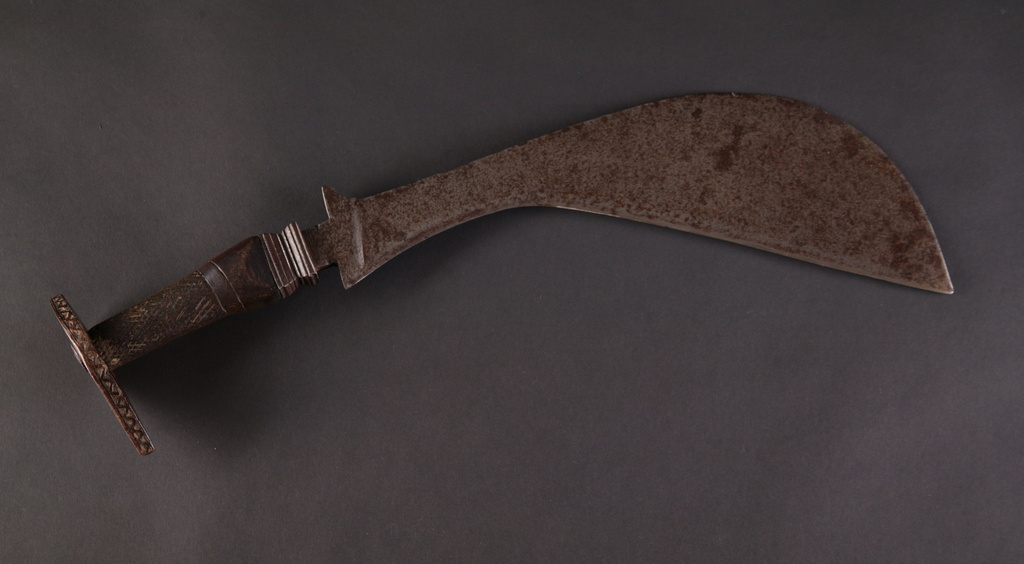
The Ayda Katti (AyudhaKathi) or more commonly known as Odi Katti was the national sword of the Coorgs . The large well forged blade is sharp on the concave side, and the base of the blade is very thick. The handle is made from two pieces of horn and has a very good patina from age and use.


Creative Commons Licence
This work is licensed under a Creative Commons Attribution-NonCommercial-NoDerivs 2.5 India License.
Read More …